
Georgia Parole and Probation Compared
Parole and probation can both place a person in the community under rules, but they begin in different ways. The State Board of Pardons and Paroles may grant parole so part of a Georgia prison term is served outside prison. A judge imposes probation as part or all of a sentence. A split sentence may include prison followed by probation. Neither status is the same as an unconditional discharge, and neither should be inferred merely because a name no longer appears on a jail roster.
Since July 1, 2015, the Georgia Department of Community Supervision, or DCS, has supervised adult felony probationers and parolees. The Board still makes parole decisions. Courts still impose probation. DCS carries out supervision in the community through field offices, many of which cover a judicial circuit or several counties. That division of authority determines where a record must be checked.
| Point | Parole | Probation |
|---|---|---|
| How it starts | A discretionary Board decision during a prison term | A sentence or later order from a court |
| Decision record | Board file, TPM information, and parole certificate | Sentencing docket, probation order, and later court orders |
| Public first check | State Board Parolee Database | The sentencing court docket or clerk |
| Community supervision | DCS field office | DCS for adult felony probation |
| Best end-status proof | Parole discharge documentation | Termination or discharge order and DCS confirmation |
A few terms keep the record trail clear:
- Parole
- Conditional release from prison before the maximum sentence date, subject to Board action and community supervision.
- Probation
- A court-imposed sentence served in the community under stated terms.
- Discharge
- The documented end of the applicable supervision obligation.
- Absconder
- A supervision term for a person alleged to have stopped reporting or left supervision without authorization.
Verify Georgia Post-Release Supervision
Start with the legal source that created the status. The public Georgia Parolee Database is the direct statewide check for parole. Georgia does not provide a comparable public, name-based DCS locator for every probationer. Probation usually requires the sentencing court docket, the clerk, the proper DCS field office, or a focused records request. A GDC inactive result helps establish that prison custody ended, but it does not resolve current supervision.
The official Parolee Database shows the statewide search route used for a person believed to be on parole.
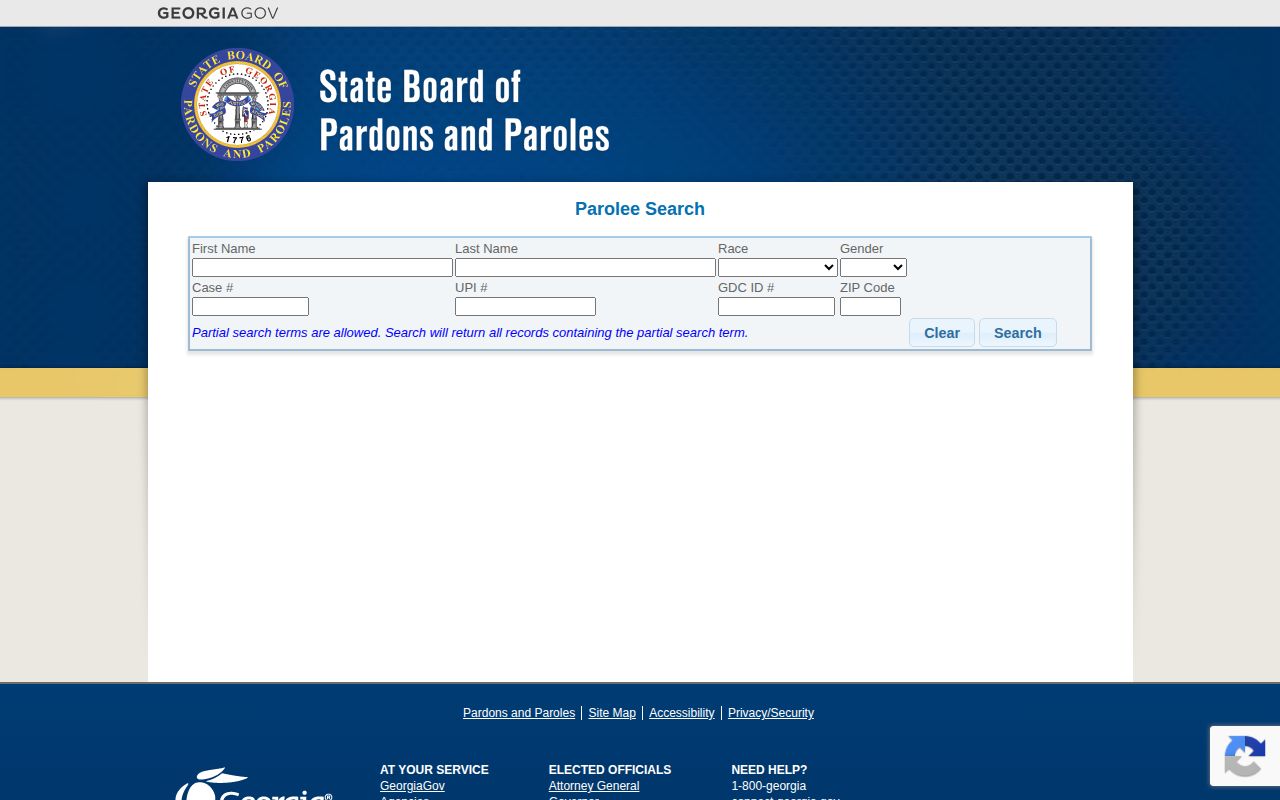
This source answers a narrower question than a prison locator: whether a matching public parole record can be found after release.
- Decide whether the known order is parole, probation, or a split sentence. Use the sentencing paperwork when available.
- For parole, search the Board database and compare identifying details before treating the result as a match.
- For probation, locate the sentencing court docket. Read the sentence, later modifications, revocation entries, and any termination order.
- Use the DCS field-office directory to find the office serving the county or judicial circuit shown in the record.
- If the public sources remain unclear, request a narrow status or discharge record from DCS, the Board, or the court custodian.
Names can match. Dates and agencies matter. Compare a full name with a date of birth, GDC identification number, conviction county, court case number, and the office shown in the public record. When a county jail release is the only known event, begin with that county’s jail and court trail rather than assuming the person entered state prison. The statewide routes for each custody layer are summarized with Georgia released inmate searches on the home page.
Georgia DCS Supervision Offices
DCS organizes supervision through field offices across Georgia. A field office may serve more than the county where its building sits, which is important in rural circuits. The office finder is therefore more reliable than guessing from a courthouse address. Select a location and check the stated service area before making a records inquiry. The office is a verification route, not a public promise that staff can disclose every part of an individual file.
The DCS field-office directory provides the official statewide map and office listings.
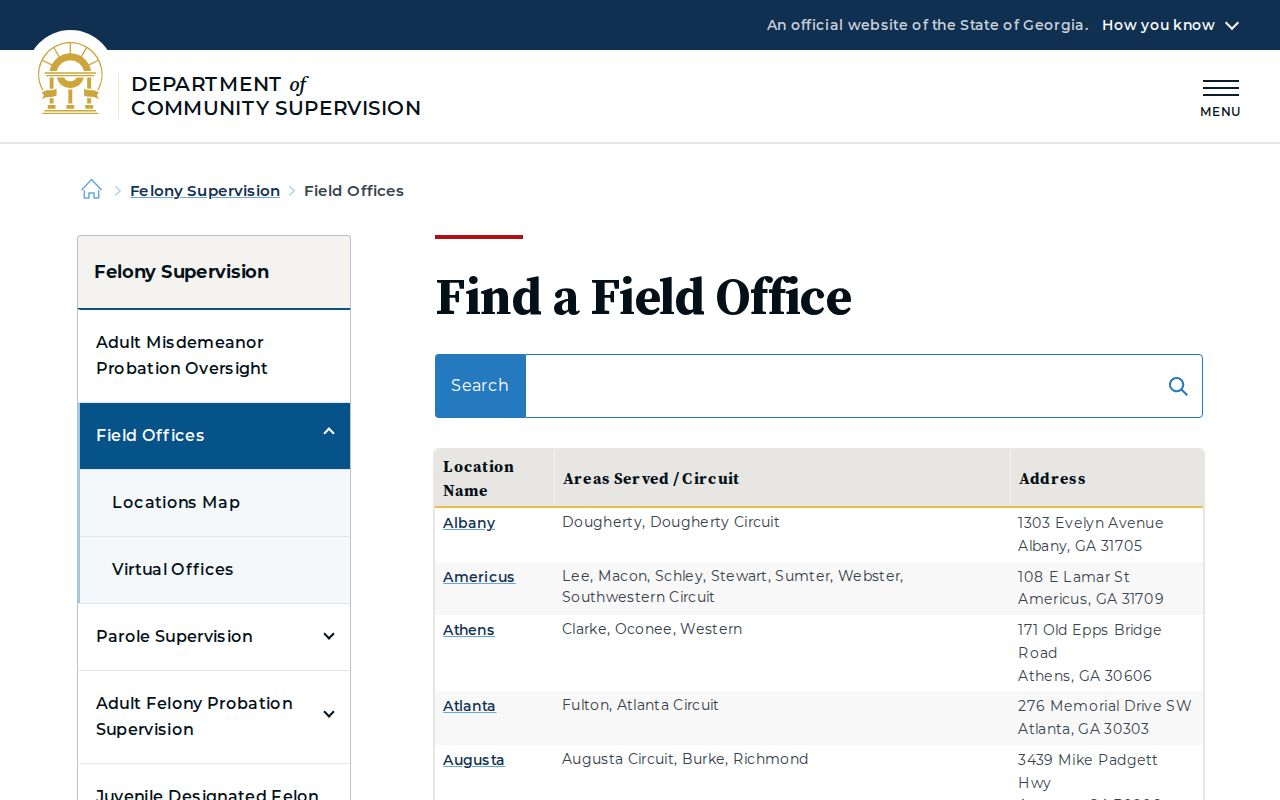
The directory helps route a Georgia probation or parole question to the office serving the relevant county or judicial circuit.
Georgia Department of Community Supervision
Statewide agency for adult felony probation and parole supervision
A useful inquiry names the person, the sentencing county, the court case if known, and the type of record sought. Ask for the public portion of a current supervision status, office assignment, or discharge document. Broad demands for a whole file are more likely to include restricted material and take more review. Georgia law permits lawful redaction of confidential, victim, security, medical, and other exempt content.
Note: A DCS office that serves a county may be physically located in a neighboring county within the same circuit.
Georgia Supervision Record Layers
No single Georgia search proves every stage from prison release through final discharge. GDC records prison status and an actual release date when present. The Board records parole consideration and public parole information. DCS manages community supervision. Courts hold probation sentences, modifications, revocations, and termination orders. Each source answers a different question, so a sound check follows the status across those layers.
The GDC offender-search form offers active, inactive, and combined search scopes.
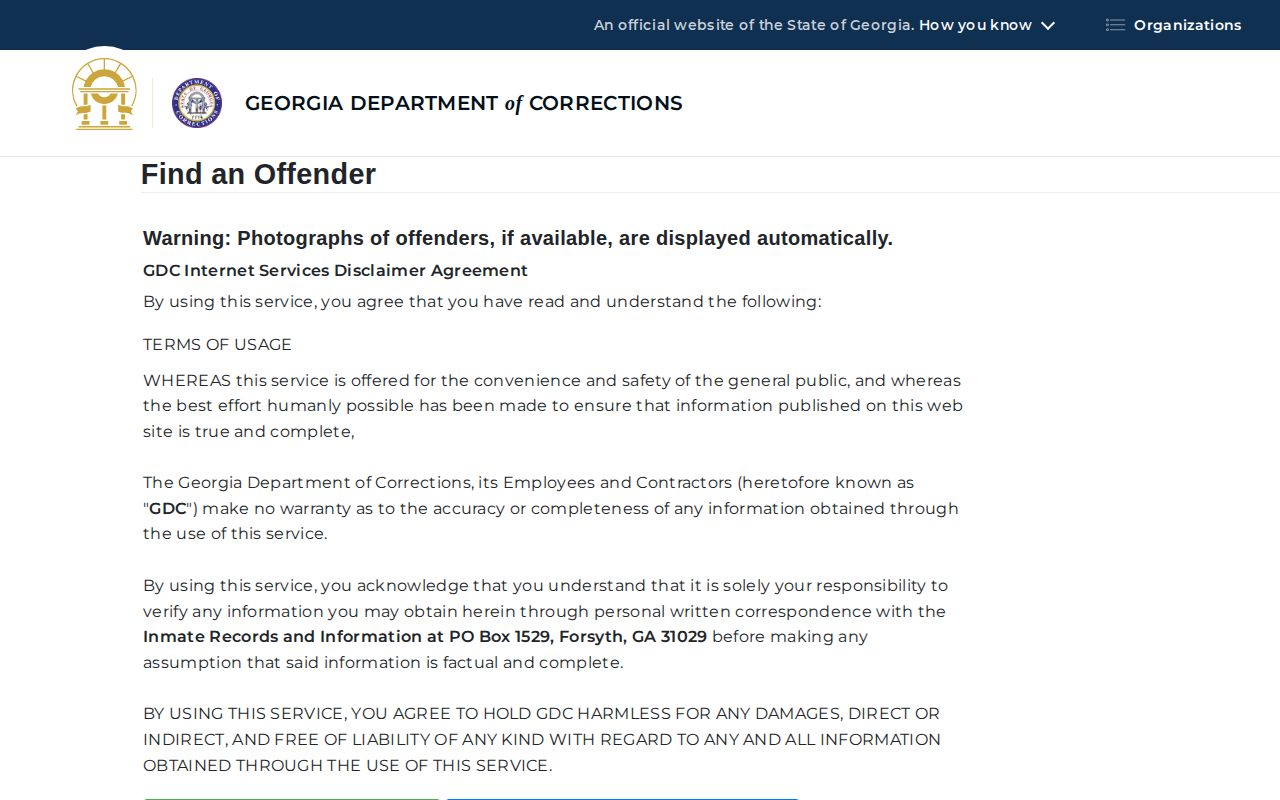
An inactive GDC record can show that state incarceration ended, then the Board, DCS, and court sources establish what followed.
| GDC offender search | Active or inactive state-prison scope, actual release date when shown, sentence and institution details |
|---|---|
| Parolee Database | Public parole record for a person who has entered the parole population |
| DCS field office | Office routing and agency-held supervision records |
| Sentencing court | Probation order, sentence changes, revocation, and termination or discharge orders |
| County jail record | Local release time, release reason, and transfer destination when held by the jailer |
A transfer can break the apparent trail. Leaving a county roster may mean movement to GDC, another jail, federal custody, or ICE, not release to the community. Likewise, leaving GDC for parole means the prison portion changed, not that supervision ended. The agency labels should be preserved exactly when dates or statuses are recorded.
Georgia Supervision and Violations
Supervision conditions arise from the parole certificate, probation order, and lawful instructions of the supervising authority. A claimed violation may lead to review, a warrant, court action, or a Board response, depending on whether the underlying status is probation or parole. The public release entry does not show the full later history. Current status must be checked with DCS, the court, the Board, or the relevant law-enforcement agency.
An absconder question requires special care. No complete official public statewide DCS absconder list was identified in the Georgia research. A person’s absence from a web list cannot prove that no warrant exists, and an old release date cannot prove that supervision remains in good standing. Confirm a claimed warrant through the authority that issued or holds it. Court dockets may show a probation warrant or revocation filing, while parole matters follow the Board and DCS record trail.
The Board’s Georgia parole-process explanation shows that release follows a continuing decision process rather than one fixed web status.
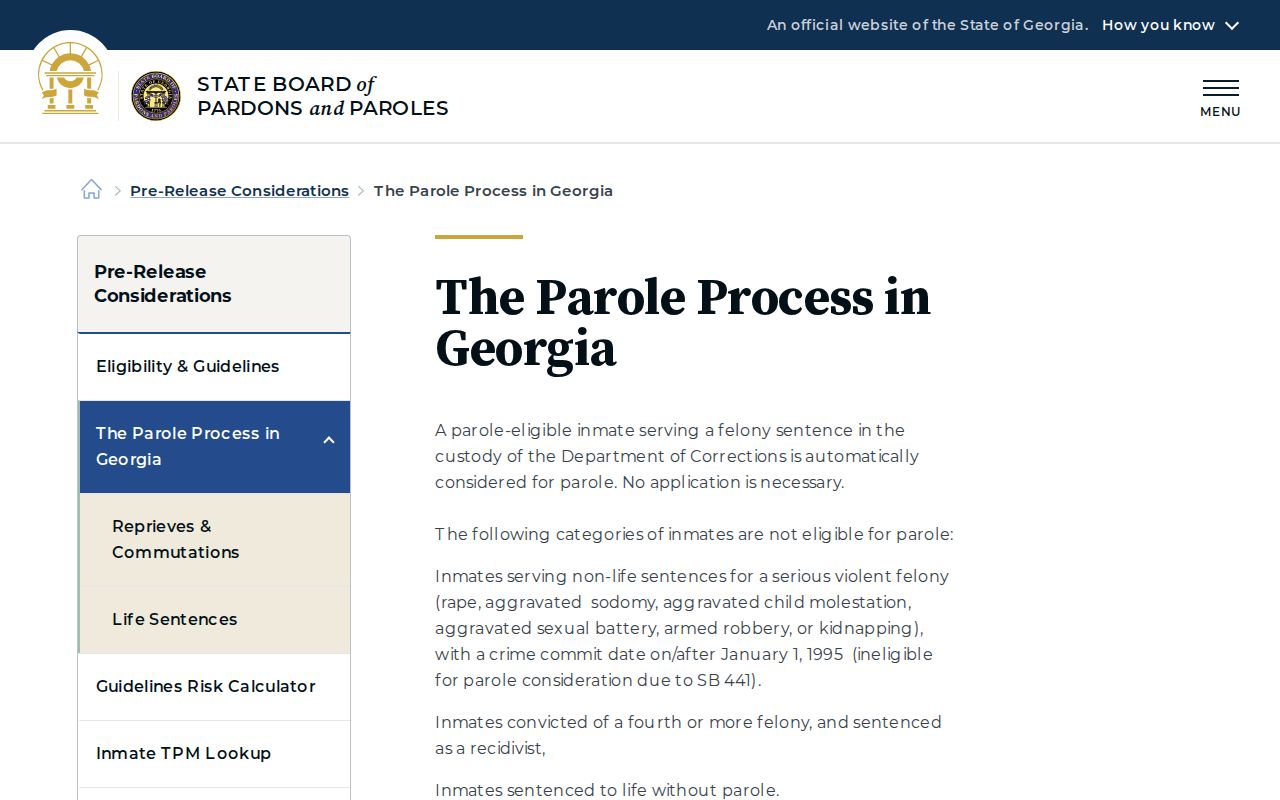
The same distinction carries past the prison gate: the parole decision, community status, and final discharge are separate records.
Georgia VINE may provide custody or status notifications when a participating feed supplies them, but it is not a complete historical supervision archive. A VINE result should be reconciled with the reporting agency. It does not replace the sentencing court or DCS when the question concerns felony probation.
Request Georgia Supervision Records
The Georgia Open Records Act, O.C.G.A. §§ 50-18-70 through 50-18-77, supplies the general public-record framework. Section 50-18-71 generally requires an agency to produce responsive records within three business days or explain what exists, the lawful basis for withholding, and the expected timetable and cost when production cannot occur in that period. Authorized search, retrieval, redaction, and copying charges may apply.
Direct the request to the record owner. DCS is the logical source for its supervision records. The Board handles its parole and clemency records. A sentencing court or clerk holds probation orders and docket entries. State the person’s full name, date of birth if known, GDC number or case number, sentencing county, and approximate period. Then ask for a defined record, such as the public portion of an assignment, termination, discharge, or revocation document.
Parole files may contain confidential material that is not open merely because the person was released. Requesting segregable public portions is more precise. It also avoids treating an internal case file as though it were the same as the public parole result. A screen image is useful for routing, but an agency-produced order or certificate is stronger proof of final status.
Note: Preserve the exact agency label, date, and date checked so later changes can be reconciled with the source record.
Georgia Parole Completion Measures
The Board’s dated statewide figures add context without deciding any one person’s status. It reported a parole population of 15,105 at the start of fiscal year 2025 and 14,568 on June 30, 2025. The reported successful-completion rate for that fiscal year was 73 percent. Those measures describe the statewide parole population for a fixed reporting period. They are not a live person lookup and should not be used to infer the outcome of an individual case.
The Board’s parole-population material is the source for those dated measures. Its definitions and reporting period matter when comparing one year with another. Probation has a different court and DCS record path, so parole figures should never be relabeled as the full number of people under all forms of Georgia community supervision.
Georgia Release Is Not Discharge
A prison release date marks the end of a custody phase. It may begin parole or probation instead of closing the whole case. Georgia’s agency structure makes that distinction visible: GDC can mark a person inactive, the Board can show parole information, and DCS can still supervise the person in the community. A completion or discharge record is the stronger source when the question is whether supervision ended.
For probation, look for a court termination or discharge order and confirm it with the clerk or DCS. For parole, request the applicable discharge documentation from the Board or DCS. A past end date in a public database can guide the request, but it should be checked for later revocation, tolling, or another order. “Tolling” means a period may not count toward completion under the controlling action.
This is Georgia’s distinctive discharge trail. The Board makes the parole decision, DCS manages community supervision, and the responsible authority documents its end. Disappearance from a prison search is only one part of that sequence. The record flow is: sentence or parole action, community supervision, any later modification, then a final completion or discharge document.