
Georgia Parole Review Process
The State Board of Pardons and Paroles holds Georgia’s constitutional clemency authority. Its five members decide whether eligible people serving state-prison sentences receive parole. That function is separate from the Georgia Department of Corrections, which keeps prison and sentence records, and from the Department of Community Supervision, which supervises people in the community after parole begins.
Ordinary parole consideration is an administrative file review. It is not generally placed on a public calendar as an individual courtroom hearing. Board investigators gather legal and personal-history material. The review can include GDC conduct, programs, institutional facts, and an acceptable residence plan before release. Correspondence may be submitted while the person is incarcerated, but the research does not support promising a public appearance or a public case-hearing date.
The Board’s official parole-process explanation describes the path from investigation through a Board decision.
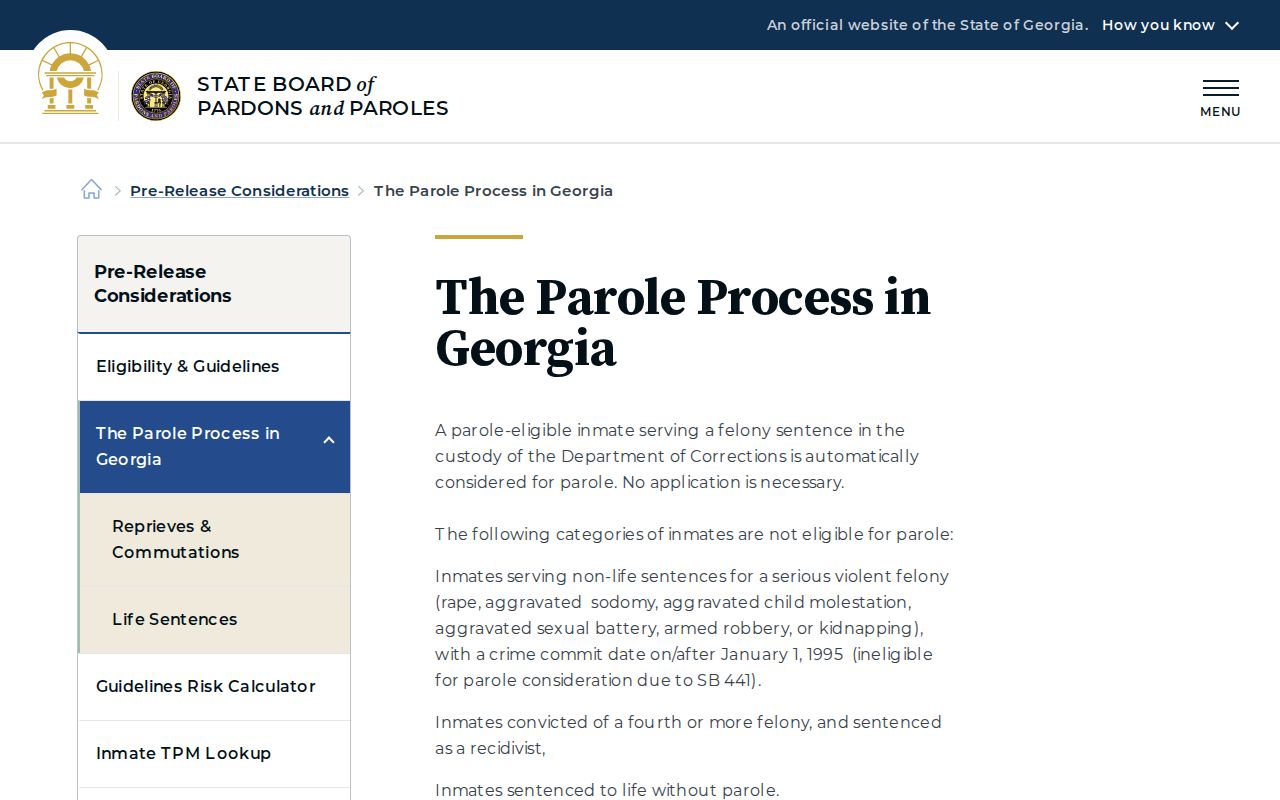
The source shows why eligibility, a Board decision, a tentative month, and actual release must be read as distinct steps.
The basic record flow is: statutory eligibility, investigation, guideline review, member votes, a tentative parole month or denial where applicable, final review, and then a release action if all required conditions remain satisfied. Detainers, new information, conduct, or an unverified residence plan can affect what follows. A prospective marker must not be restated as a guaranteed pickup date.
Find Georgia Parole Review Timing
A request for an individual “hearing date” must first be reframed to match Georgia’s actual system. There is no verified statewide public calendar listing a courtroom-style hearing date for each parole-eligible inmate. For a non-life case, the closest public case-specific route is the Inmate TPM Lookup. TPM means Tentative Parole Month. It is a prospective month for final parole review, not a hearing appointment and not a promise of release.
The Board’s TPM information page explains the meaning and limits of a tentative parole month.
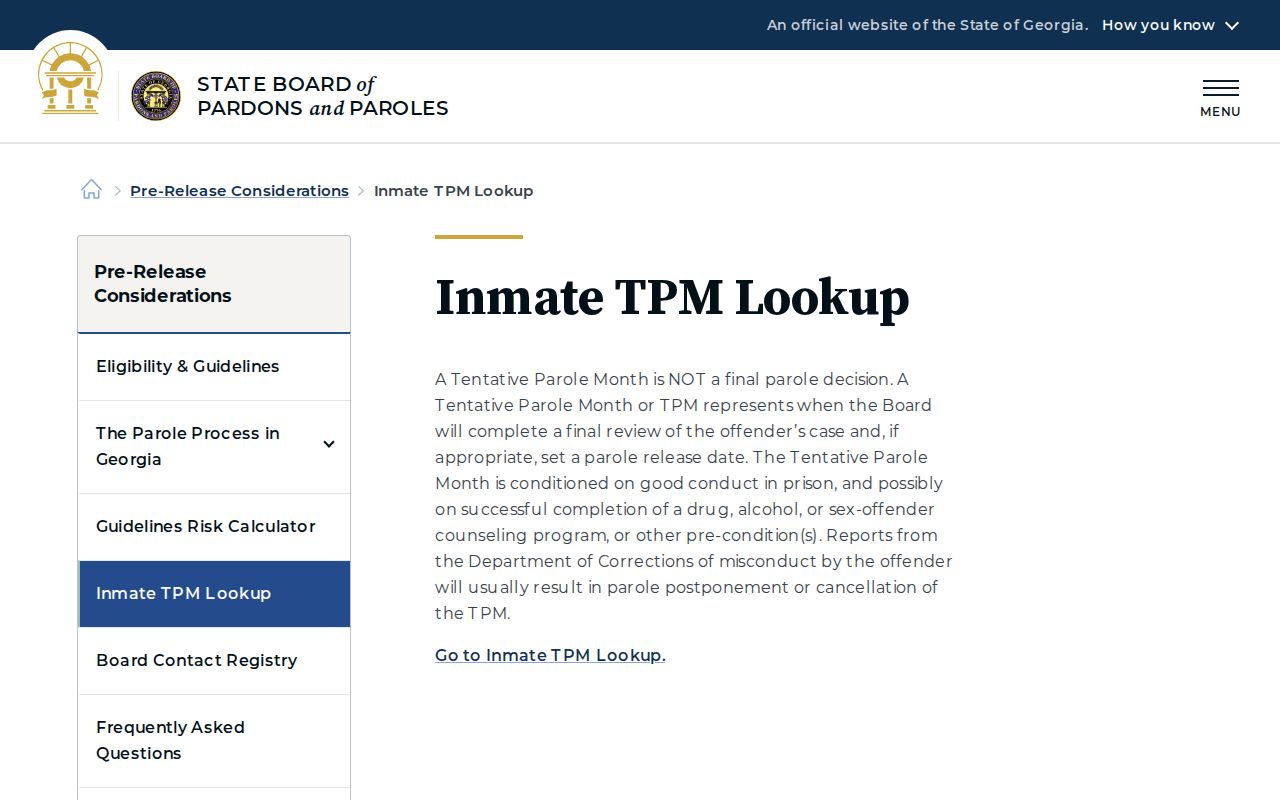
The official explanation is the safest source for interpreting timing before opening the person-specific application.
- Confirm that the person is in GDC custody and that parole consideration is the relevant process, rather than a county case or federal sentence.
- Open the Board’s TPM explanation before treating any month as a firm release date.
- Use the Inmate TPM Lookup for the case-specific status that the public application makes available.
- Match the person carefully with identifying and sentence details. Do not rely on a name alone.
- Read the exact decision marker and check date. If no public result resolves the question, use the Board’s records or correspondence route.
Public Board meetings are a different category. The Board publishes dated agendas, press releases, and video entries as meetings are scheduled. Its archive shows meetings at recurring but not strictly monthly intervals. Those public sessions should not be presented as the personal parole calendar for every incarcerated person.
Search Georgia Parole Decisions
The Inmate TPM Lookup is Georgia’s closest statewide public decisions-and-results tool for an incarcerated person in a non-life case. It can report a Board parole-status marker, such as a TPM or other decision information available in the live tool. It is not the same as the Parolee Database, which applies after a person enters the parole population.
The official TPM application provides the case-specific search route.
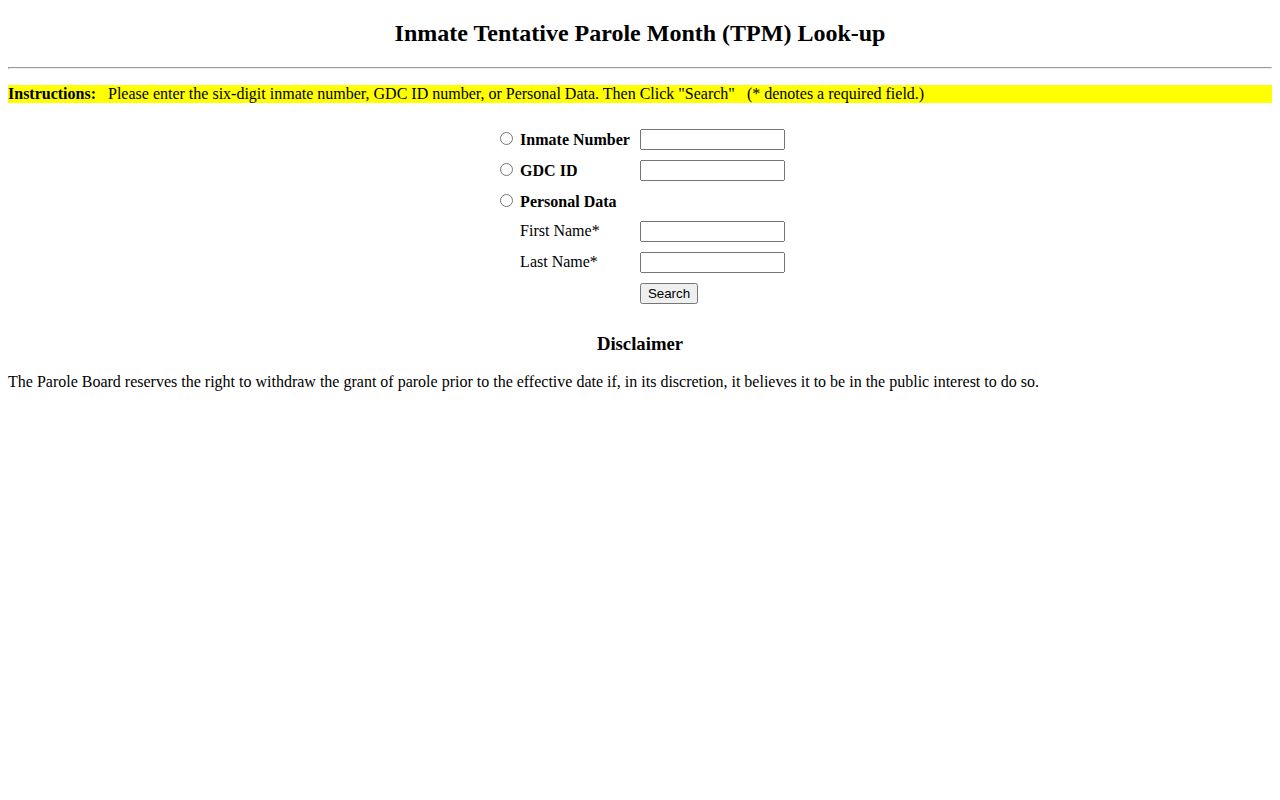
A result should be recorded in the tool’s own words, with the date checked, because the Board may revisit a decision before release.
- Open the TPM application from the official Board domain and enter the person details requested by the live form.
- Compare the returned identity and custody facts with the GDC record before accepting a match.
- Copy the exact status or TPM wording. Do not substitute “granted” for a tentative marker unless the source itself supports that statement.
- Check the GDC offender record for active custody, maximum-release information, and any later actual release date.
- After release on parole, move to the separate Parolee Database to check the public parole record and supervision trail.
A missing TPM result does not prove ineligibility or denial. Life cases can follow a different eligibility and review path, filters can fail, and not every decision detail is public. A narrow Board open-records request may identify public material, but confidential parole-file information can be withheld under Georgia law.
Note: Keep the lookup date with the result because Board action and release conditions can change after an online check.
Georgia Parole Decision Outcomes
Parole outcome terms describe stages, not interchangeable promises. Georgia’s public material supports a distinction among eligibility, denial, a set TPM, later Board reconsideration, and an actual parole release. A recommendation produced by decision guidelines is advisory. The Board can accept or reject it, deny parole, or set a tentative month. Even after a favorable marker, the Board may reconsider before release.
| Outcome or marker | Meaning | Next record to check |
|---|---|---|
| Eligible for consideration | The statute permits review; release is not guaranteed | Board process and TPM lookup |
| TPM set | A tentative month for final review, not a fixed release day | TPM lookup and later GDC record |
| Parole denied | The Board did not approve parole at that review | Exact Board result and any future consideration information |
| Decision reconsidered | The Board changed or revisited action before release | Most recent Board status |
| Parole certificate release | GDC recorded a custody-ending parole release action | Actual release date, Parolee Database, and DCS |
| Parole discharge | The applicable parole obligation ended through official action | Board or DCS discharge document |
A denial does not convert the maximum sentence date into a new Board-set release date. A TPM does not erase the maximum release calculation. Similarly, a parole certificate in GDC release statistics marks a prison release type, while discharge from parole is a later status. Preserve all three agencies’ labels so the record does not collapse separate events into one.
GDC’s fiscal year 2025 release profile counted 4,033 parole-certificate records among 13,523 administrative release records. That is a dated systemwide count, not a current grant rate and not proof about a named person. The same report includes sentence expirations, transfers, reprieves, out-of-state actions, and deaths, which shows why the broad word “release” must be tied to its exact type.
Georgia Parole Eligibility Rules
O.C.G.A. § 42-9-45 supplies Georgia’s general parole-eligibility framework. The Board summarizes the common rule as eligibility after one-third of the sentence for most parole-eligible prisoners. Eligibility means consideration, not a right to parole. People generally do not submit an ordinary parole application because eligible GDC inmates are considered automatically.
Major exclusions matter. The Board identifies life without parole, qualifying recidivist sentences, and non-life serious violent felony sentences for crimes committed on or after January 1, 1995 among categories excluded from parole. Life-sentence eligibility varies with the offense and date. The Board’s public summary describes common thresholds of seven, fourteen, or thirty years for different groups, so a life case cannot be reduced to one statewide formula.
O.C.G.A. § 42-9-40 requires parole guidelines. The Board explains that a hearing examiner combines crime severity and a risk score to produce an advisory months-to-serve or percentage recommendation. The five-member Board is not bound to follow that result. This is the key difference between a guideline estimate and an actual Board decision.
- Eligibility
- The legal point at which a person may be considered for parole.
- Guidelines
- An advisory framework using offense severity and a risk score.
- TPM
- A tentative parole month used for prospective final review.
- Maximum release date
- GDC’s prison-sentence calculation, distinct from the Board’s TPM.
Note: Sentence date, offense, recidivist status, and life-sentence terms can change the eligibility analysis for a Georgia case.
Georgia Decisions After Parole Release
Once parole release occurs, the correct public route changes. The TPM application concerns a person still in the consideration stage. The Parolee Database concerns someone in Georgia’s parole population. DCS then manages community supervision. A GDC inactive status and actual release date establish a prison event, but they do not prove that parole supervision has ended.
The official Parolee Database illustrates the separate post-release record layer.
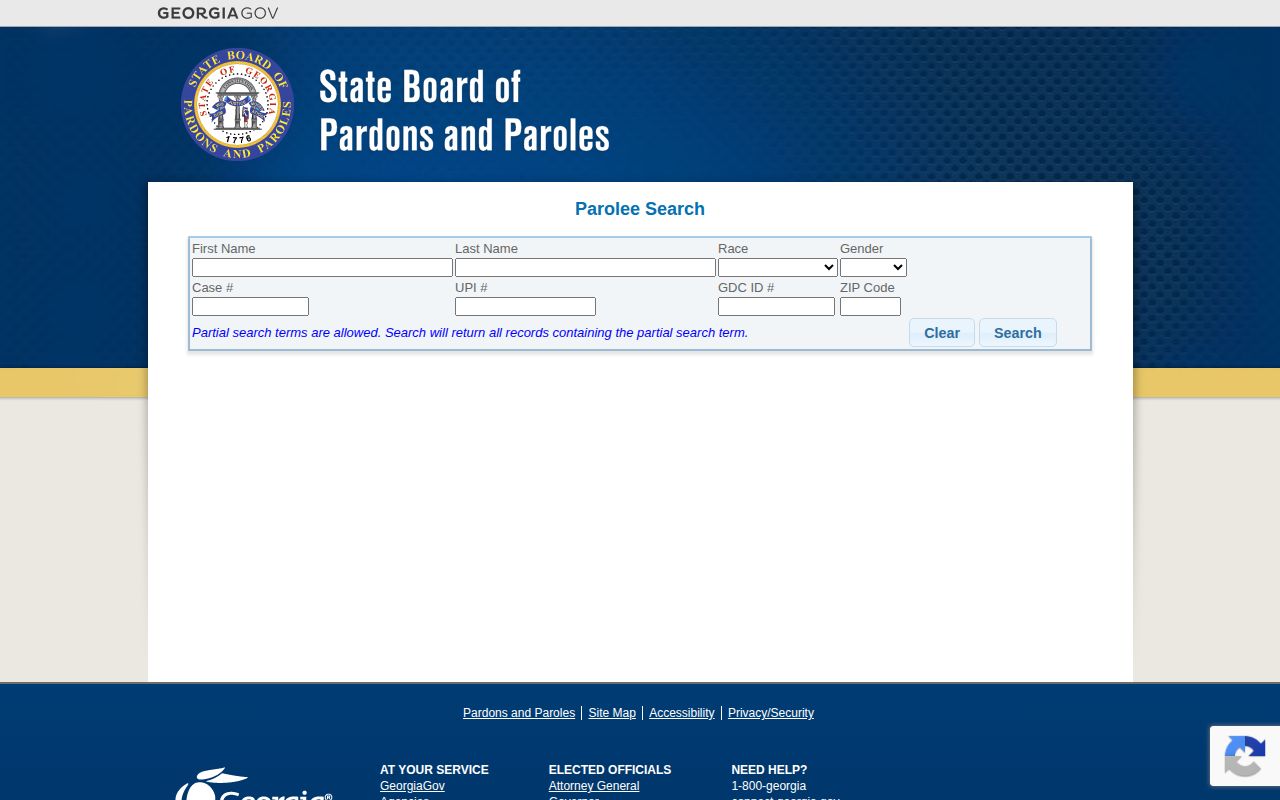
The lookup belongs after the Board decision and prison release, while a final discharge document belongs at the end of supervision.
Search results should be reconciled with any revocation, tolling, later Board action, or court record. A person can be out of prison yet remain under parole. If a public end date appears, request the underlying discharge record when documentary proof matters. Georgia probation and parole verification uses the Board, DCS, and court layers to distinguish release from final discharge.
Georgia Board Meetings and Records
Public Board meetings should be checked through the agency’s dated announcements and video archive. The research found examples in January, April, June, and September, but not a strict monthly cadence. The accurate rule is that agendas and meeting material appear as meetings are scheduled. Those materials document the Board’s public work, not an individual hearing list.
When the TPM lookup or public meeting material does not answer a records question, use the Board open-records request. Identify the person and requested public record as narrowly as possible. Useful identifiers include full name, GDC number, date of birth if known, conviction county, case number, and an approximate review period. Ask for the public decision or order rather than a sweeping parole file.
Georgia’s Open Records Act generally calls for production or an agency response within three business days. If records cannot be produced in that period, the response should explain the records, timetable, estimated cost, and legal basis for withholding. Confidential parole materials and other exempt information may be withheld or redacted. A request for segregable public portions respects that boundary and makes the sought record clearer.
Georgia Pardon Orders After Release
A pardon is a separate form of clemency. It is not an ordinary parole-hearing outcome, not a finding that the person was innocent, and not proof that the custody or release record vanished. The State Board of Pardons and Paroles also handles pardon and restoration matters, but those applications and orders should not be confused with the TPM process used for an incarcerated person’s parole consideration.
Georgia moved pardon and restoration applications to an electronic process effective January 2, 2024. The Board’s pardons and restoration page also provides a way to request an emailed copy of an order that was previously granted. That order is its own document. A later record-restriction process, if any, is a different legal path and cannot be inferred from the pardon alone.
For a past case, identify which record answers the question. A TPM or denial belongs to parole consideration. An actual release date belongs to the custody record. A parole discharge documents the end of supervision. A pardon or restoration order records separate clemency action. Keeping those documents apart prevents a favorable Board action from being misstated as erasure of the earlier case history.